

Adina Mosque: An architectural gem of the golden age of united Bengal and Bengali identity.
The Adina Mosque in Malda, built during the reign of Sikandar Shah, the second Sultan of the Iliyas Shahi dynasty, between 1373 and 1374 AD, is the largest architectural monument in the Indian subcontinent and one of the grandest in the entire Muslim world, crafted by Bengali masons and stone carvers. Measuring approximately 524 feet long and 322 feet wide, with 260 pillars and 387 domes, this massive architectural marvel was not merely a place of worship; it stood as a symbol of the strength, power, nobility, and pride of the Bengal Sultanate, standing tall against the Delhi Sultanate of that era.
Support Bengal Frontier
Help us tell the stories that matter.
Later, when Raja Ganesha briefly seized power in Bengal, he also chose this very mosque to showcase his power. He converted it into his Kachhari Bari (courtroom or administrative building) and reshaped the mosque’s entrance in the style of a Hindu temple. He also placed several idols of gods and goddesses on the walls of the mosque. The origin of the controversy surrounding the historic Adina Mosque dates back to that time.
The Historical Context of the Mosque’s Construction
In 1338 AD, following the death of Izzuddin Yahya, the Governor of Lakhnauti under the Delhi Sultanate, Malik Haji Shamsuddin Iliyas Shah emerged as the independent ruler of Saptagram in 1339. At that time, Bengal was divided into three provinces under the allegiance of the Delhi Sultanate: Lakhnauti (North and West Bengal), Saptagram (South Bengal), and Sonargaon (East and Southeast Bengal). Shamsuddin Iliyas Shah conquered Lakhnauti in 1342 and Sonargaon in 1352. By unifying these three regions, he established himself as the undisputed sovereign Sultan of all Bengal.
Sultan Shamsuddin Iliyas Shah proclaimed the unified territory as an indivisible Bengal Sultanate and assumed the titles “Shah-i-Bangalah” and “Sultan-i-Bangalah”. His ambitions did not stop there; in 1350 (or late 1349, according to some sources), Sultan Iliyas Shah led a highly successful and historic military campaign into the Kathmandu Valley with his Bengali army. Traversing the Terai region, his forces advanced from the plains into the hills and swiftly entered the Kathmandu Valley. According to contemporary Nepalese records and inscriptions at the Swayambhunath Stupa, Shah’s army launched extensive assaults on the cities of Kathmandu, Bhaktapur (Bhadgaon), and Lalitpur (Patan). Unable to withstand this sudden and formidable invasion, Nepal’s weak ruler offered little resistance, allowing the Sultan’s forces to return to Bengal laden with immense treasure, gold, silver, and precious artifacts. No other ruler before or after Iliyas Shah ever executed a military campaign of such scale in the Himalayan region. This victory vastly enhanced his military prestige along the northern frontier. Subsequently, he launched further campaigns, expanding his domain eastward to Guwahati in Assam, southward to Chilika in Odisha, and westward by annexing Bihar, where he founded the fortified city of Hajipur.
The rising power of Bengal’s Sultan was viewed by the Sultan of Delhi, Firoz Shah Tughlaq, as a direct threat. In 1353 AD, Firoz Shah Tughlaq marched on Bengal with a massive army. Strategically, Iliyas Shah evacuated his capital and took refuge in the impregnable fortress of Ekdala. The Delhi forces laid a prolonged siege to the fort but failed to breach it. Eventually, Iliyas Shah’s army of 180,000 troops launched a fierce surprise counteroffensive from within the fort—an engagement recorded in history as the First Battle of Ekdala. Through the ultimate sacrifice of Sultan Iliyas Shah’s Hindu general, Sahadeva, alongside numerous Hindu and Muslim Bengali soldiers, the independence of Bengal was safeguarded. Firoz Shah Tughlaq was forced to sign a peace treaty with Iliyas Shah before retreating to Delhi. Through this treaty, the Delhi Sultanate was compelled to indirectly recognize Bengal’s independence.
Following Sultan Iliyas Shah, his son Abul Mujahid Sikandar Shah ascended the throne of Bengal, inheriting his father’s bold ambitions. He conquered Assam and Odisha, and invaded Tripura, expelling King Raja-Fa and installing Ratna-Fa on the throne. Sikandar Shah bestowed the title “Manikya” upon Ratna-Fa, an event documented in detail in the Rajmala (the chronicle of Tripura’s kings).
During his reign, Sultan Firoz Shah Tughlaq invaded Bengal a second time in 1359, personally leading a formidable force comprising 80,000 cavalry, 470 war elephants, and a massive infantry contingent. Yet once again, Firoz Shah Tughlaq was forced to concede defeat and sign a treaty formally recognizing Bengal as an independent, sovereign state. Following this decisive failure, the Pathan Sultans of Delhi never dared to invade Bengal again.
It was to celebrate this absolute political independence—wrested through two consecutive victories over the Delhi Sultanate—that Sultan Sikandar Shah envisioned the grand construction of the Adina Mosque in Pandua. Through this monumental architectural undertaking, he sought to send an audacious message to Delhi. In scale and grandeur, the mosque far surpassed the Begumpur Mosque built by Delhi’s Firoz Shah Tughlaq, standing as an enduring symbol of Bengal’s sovereign power and imperial pride.
An Architectural Marvel
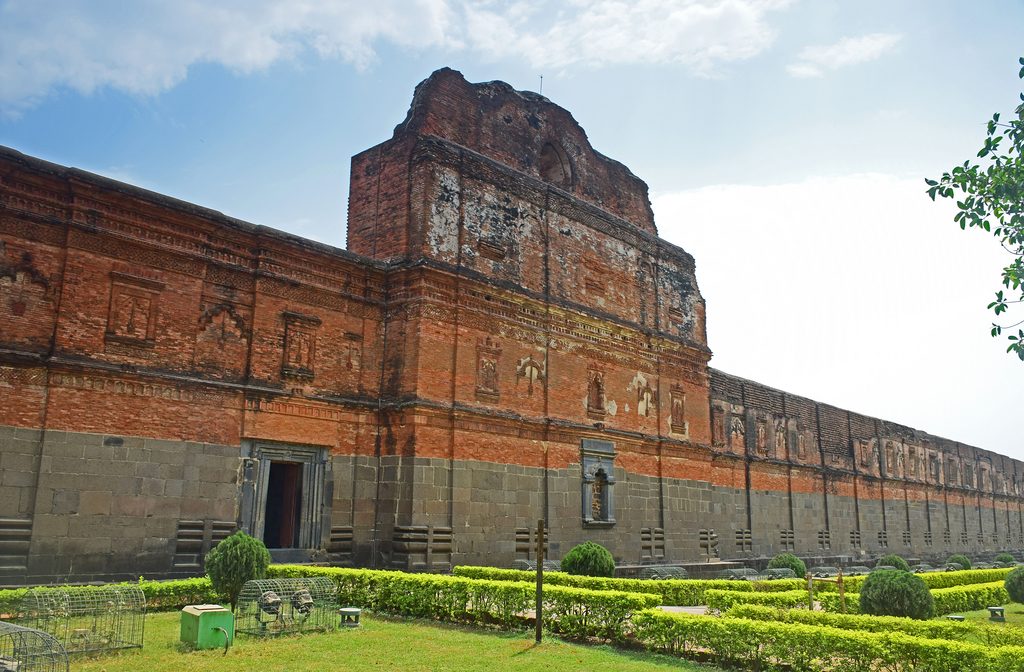
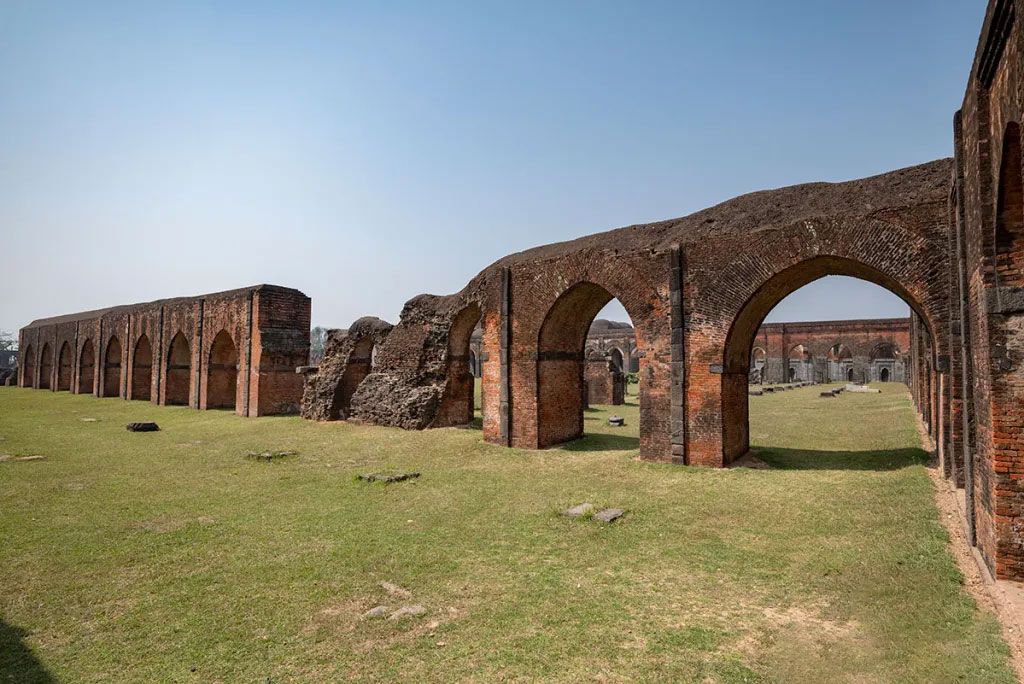
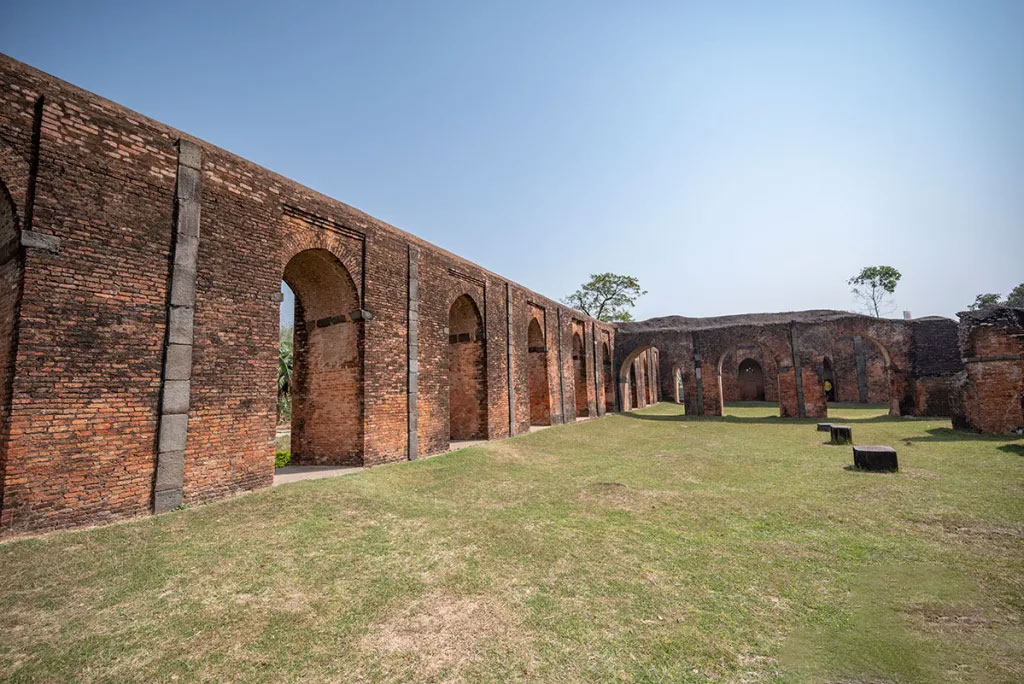
Measuring 524 feet from north to south and 322 feet from east to west, the mosque is supported by 260 pillars and capped by 387 domes. Its design seamlessly integrates Bengali, Arab, Persian, and Byzantine architectural traditions. The Adina Mosque rivals the great contemporary mosques of Damascus, Baghdad, Córdoba, or Cairo—not merely in size and expanse, but also in the sophistication of its craftsmanship and layout. At its center stands a colossal vaulted hall, or Iwan, inspired by Persian and Central Asian architectural idioms (most notably the Umayyad Mosque of Damascus). A central vault of such imposing dimensions was unprecedented in the Indian subcontinent at the time.
Inscriptions within the mosque describe Sultan Sikandar as “the most generous, perfect, wise, exalted, and just Sultan among the rulers of the Arabs and non-Arabs (Arab wa ‘Ajam).” Further epigraphs proclaim Sikandar Shah as “the Supreme Sultan” and “the Caliph of the Faithful.”
The ornamentation fuses local motifs with Iranian artistic traditions. Rendered throughout are hanging lamps on long chains, florals, bells, blooming lotuses, branching trees, niches, and stylized water pots (ghata). It is widely believed that the artisans executing these works were local Hindu Bengali craftsmen who naturally channeled their mastery of traditional terracotta ornamentation into the structure. The entire western wall is adorned with this intricate terracotta work, while the stylized trees, vines, and floral arabesques draw heavily from Persian aesthetics.
Historian Richard Eaton notes that “the royal grandiosity of the mosque’s western façade evokes the splendour of pre-Islamic Persia. The wall functions as a multi-tiered backdrop, featuring alternating niches that cast precise horizontal and vertical shadows—a feature virtually unique in Indo-Islamic architecture. It strongly recalls the exterior façade of Taq-i Kisra, the grand Sasanian palace at Ctesiphon. This influence is especially pronounced in the design of the prayer sanctuary. Coupled with terracotta artwork directly inherited from the Pala-Sena period, the Adina Mosque stands as a masterly synthesis of Arabo-Persian and Bengali architectural heritage. “This wall is a huge multistoried screen, whose exterior surfaces utilize alternating recesses and projections, both horizontally and vertically, to produce a shadowing effect. Whereas such a wall has no clear antecedent in Indo-Islamic architecture, it does recall the external facade of the famous Taq-i Kisra palace of Ctesiphon (third century A.D.), the most imposing architectural expression of Persian imperialism in Sasanian times (A.D. 225—641). Even more revealing in this respect is the design of the mosque’s central nave. Whereas the sanctuary of the Tughluqs’ Begumpur mosque in Delhi was covered with a dome—a feature carried over, together with the four-iwan scheme, from Seljuq Iran (1037-1157) to India in the twelfth and thirteenth centuries that of the Adina mosque is covered with a barrel vault. Never before used on a monumental scale anywhere in India, this architectural device divided the whole structure into two halves, as did the great barrel vault of the Taq-i Kisra. The mosque thus departed decisively from Delhi’s architectural tradition, while drawing on the much earlier tradition of Sasanian Iran. We know that generations of Iranian architects and rulers had considered the Sasanian Taq-i Kisra palace to be the acme of visual grandiosity and splendor, and a model to be consciously imitated. Thus Sikandar was at least an heir, if not a conscious imitator, of this tradition.”

The Center of the Mosque
– Mihrab and Minbar
(image generated using AI)

Women’s Gallery
(image generated using AI)

The Mihrab of the Adina Mosque
(image generated using AI)
Spolia
In architectural terminology, the practice of reusing building materials from conquered or preceding cultures in new structures is known as spolia. The construction of the Adina Mosque required a massive quantity of dense basalt stone and stone pillars. At the time, sourcing and transporting newly quarried stone from afar was far more challenging than salvaging materials from abandoned or damaged Sena and Pala period temples, Buddhist monasteries, and royal palaces in the vicinity. These ornate stones, arches, and pillars were integrated directly into the mosque’s foundations, walls, and mihrabs. However, there is no historical evidence to suggest that Hindu temples or Buddhist monasteries were deliberately demolished specifically to collect building materials for the mosque.
On the outer surface of the massive, fortress-like western wall, several stone blocks feature defective or incomplete carvings of Hindu or Buddhist deities and dancers. On the inner face of the eastern wall, a small stone block depicting an imperfect figure of a dancer is fitted upside down. Beneath the elevated platform where the Imam stands on the mimbar (pulpit), carvings of Hindu or Buddhist dancers are also visible—a motif commonly found in the temple architecture and Buddhist stupas of Nepal, India, and Southeast Asia. These carvings were likely covered with a layer of plaster at one time, which has now peeled away, exposing them.
The mosque provided a separate section for women to offer prayers, now referred to as the “Ladies’ Balcony.” Remnants of several chambers still survive, one of which historians believe was the tomb of Sikandar Shah.
A careful observation reveals that what is currently regarded as the main entrance was not, in fact, the principal gateway of the mosque. While the interior features grand, sweeping arches, the current main entrance lacks an arch altogether. The entrance to such a colossal mosque could not have been so small; moreover, mosque entrances are typically not situated on the western side. This was likely a private entry gate, presumably used by the women of the royal family.
Above the doorways on the western and northern sides of the mosque, carvings of Lord Ganesha are visible. The two northern doorways are lower in height than the western one. Indeed, none of the present doorways feature arches, which is highly unusual. A casual observer can see that the entire door frames, complete with stone lintels and jambs, were fitted into place at a later date.
According to Professor Sukhamay Mukhopadhyay, when mosques were built using materials from Hindu temples during the Muslim period, images of deities were typically defaced, mutilated, or inverted. In the Adina Mosque, however, most of the deity figures are intact and placed upright, with many prominently displayed on both the outer and inner walls. Furthermore, the upper panels of several doorways feature exquisitely carved Hindu deities. It is difficult to argue that these panels were brought from outside, as they fit the dimensions of the doorways precisely. Had foreign panels containing sculptures been artificially adapted to these doorways, such symmetry and seamless structural harmony would have been nearly impossible to achieve. Thus, it cannot be asserted with certainty that Sikandar Shah demolished Hindu temples to gather materials for the Adina Mosque.
An old local tradition prevalent in Pandua offers a clue. According to this tradition, after assuming power, Raja Ganesha converted the Adina Mosque into his kacheri (courtroom/administrative office). Regarding this, H.S. Stapleton wrote:
“It may also be added with reference to the supposed connection of Rājā Kāns with the Eklākhī building that local tradition states that when the Rājā obtained supreme power over Bengal after the death of the short-lived successors of Ghiyāsuddīn, out of contempt for Muhammadanism he used the adjacent Adīna mosque as his Kācherī (Magistrate’s Court or Zamīndārī Office).” (Memoirs of Gaur and Pandua, p. 126, f. n.)
This tradition may well be true. If so, it is possible that when the Adina Mosque was originally constructed, it contained no Hindu idols; rather, when Raja Ganesha seized power and converted the mosque into his administrative center, these figures were carved into the structure under his orders.
A Chinese diplomatic delegation visited Bengal during the reign of Raja Ganesha. According to their accounts, the King of Bengal received the Chinese envoys seated cross-legged on a high throne made of precious stone. It is plausible that this high stone throne refers to the mimbar of the Adina Mosque, where the Imam delivers sermons, used at a time when Raja Ganesha had converted the mosque into his kacheri bari.

Spolia—the practice of repurposing architectural elements from earlier cultures into new structures—was likely the handiwork of Raja Ganesha.

Spolia—the practice of repurposing architectural elements from earlier cultures into new structures—was likely the handiwork of Raja Ganesha.
Raja Ganesh
Who Was Raja Ganesha?
When Shamsuddin Iliyas Shah seized sovereign power and declared himself the Sultan of Bengal, he enjoyed overwhelming support from local Hindu kings and landlords (zamindars). Sahadeva, a heroic Hindu general in the Sultan’s army, sacrificed his life in the Battle of Ekdala to defend Bengal’s independence. In recognition of such valor, Iliyas Shah conferred the title of ‘Ray‘ upon local Hindu chieftains, appointed them to high administrative posts, and bestowed royal titles (Raja, Maharaja) while entrusting them with the governance of large estates.
Raja Ganesha hailed from one such prominent landlord family of Bhaturia. Remnants of his ancestral homestead can still be seen at Garhbhabanipur Mauza in the Bhaturia Union of Haripur Upazila, Thakurgaon (present-day Bangladesh). Rising through the ranks by virtue of his competence, he became an influential courtier and was eventually appointed the governor of Dinajpur.
With Ganesha’s assistance, Sultan Saifuddin Hamza Shah was assassinated, and the Sultan’s slave, Shihabuddin Bayazid Shah, ascended the throne. Shihabuddin was merely a figurehead; the real authority rested with Raja Ganesha. Later, Shihabuddin was assassinated by hitmen, paving the way for his minor son, Alauddin Firoz Shah, to take the throne. Historical evidence suggests Ganesha orchestrated these maneuvers behind the scenes. Following Shihabuddin’s death, Ganesha placed young Alauddin on the throne as a puppet ruler while wielding total control over the state himself. Eventually, Ganesha murdered Sultan Alauddin and directly usurped the throne of Bengal. Consequently, contemporary accounts describe him as an illegal usurper. This illegitimacy is likely why, despite seizing absolute power, Ganesha never dared to declare himself an emperor or Sultan. Thus, history remembers him simply as Zamindar or Raja Ganesha.
Raja Ganesha was a capable administrator. Though a devout Hindu, he initially maintained peaceful relations with his Muslim subjects, but factional tensions soon erupted. He forcibly married Phuljani Begum, the widow of Sultan Ghiyath al-Din Azam Shah, and converted the Adina Mosque into his administrative headquarters—installing Hindu idols within to project his political power. It is widely believed that Ganesha also altered the primary entrance of the Adina Mosque during this period.
As friction with his Muslim subjects reached a flashpoint, Ganesha adopted a policy of ruthless suppression. Numerous Muslim intellectuals, Islamic scholars (ulema), and Sufi saints were executed, while several mosques and seminaries (madrasas) were destroyed. In response, Nur Qutb Alam, a prominent Sufi saint of Pandua, penned a passionate letter to Sultan Ibrahim Sharqi of Jaunpur appealing for military intervention. Upon receiving the plea, Ibrahim Sharqi marched his forces into Bengal.
While Ganesha excelled at political intrigue, he lacked strategic military brilliance. Admitting defeat without putting up a fight, he was forced into a peace treaty with Ibrahim Sharqi. Under the terms of the accord, Ganesha abdicated the throne, and his son, Crown Prince Yadu, converted to Islam and ascended the throne of Bengal. Satisfied with this resolution, Ibrahim Sharqi withdrew to Jaunpur.
Upon returning home, Ibrahim Sharqi fell ill and passed away shortly thereafter. Taking advantage of his death, Raja Ganesha deposed his son Yadu, reclaimed the throne, and resumed his persecution of the Muslim population. Through an elaborate, lavish purification ritual (yajna), he forced Prince Yadu to renounce Islam and re-embrace Hinduism.
However, Prince Yadu had been deeply influenced by the Sufi saints and remained steadfast in his devotion to Islam. Rebelling against his father, Yadu was imprisoned by Ganesha. Yet even while incarcerated, the prince arranged his father’s assassination through hired assassins. Reclaiming the throne, he assumed the title Sultan Jalaluddin Muhammad Shah. Thus, Raja Ganesha’s turbulent seven-year reign came to an end.
Sultan Jalaluddin Muhammad Shah earned widespread affection among both Hindu and Muslim communities. He is regarded as one of the greatest sovereign rulers of medieval Bengal, governing the realm for 17 years.
According to Professor Sukhamay Mukhopadhyay, the Adina Mosque was restored to its original sacred purpose after Ganesha’s death. In his 15th-century Arabic work Al-Daw’ al-Lami’ li-Ahl al-Qarn al-Tasi’, scholar Al-Sakhawi recorded that upon becoming king, Ganesha’s son, Jalaluddin Muhammad Shah, restored the mosques and monuments his father had defaced or destroyed. It was during this restoration that Adina Mosque reverted to a place of worship; however, the Hindu idols embedded in the walls were not removed—they were simply covered under a coat of plaster. Fearing that extracting these stone blocks would damage the structural beauty of the mosque, Jalaluddin and subsequent Muslim Sultans chose to leave them intact.


Why Are There So Many Statues of Gods and Goddesses on the Adina Mosque?
Due to the presence of Hindu and Buddhist deity figures on the Adina Mosque, extremist Hindutva elements claim that an ‘Adinath Shiva Temple’ originally stood at the site and that the Adina Mosque was constructed by demolishing it.
However, there is no historical evidence or logical basis behind this claim. The name ‘Adina Mosque’ bears no connection to ‘Adinath’. In Persian, ‘Adina’ translates to Friday —meaning the Adina Mosque was simply the royal Friday Congregational (Jami) Mosque. Nowhere in contemporary or later Bengali literature, poetry, Mangalkavya, nor in the travelogues of foreign ambassadors and travelers, is there any mention of a temple being demolished to build this mosque.
Sultan Shamsuddin Iliyas Shah and Sultan Sikandar Shah were both legendary conquerors. Through their military campaigns, they expanded their domain from Assam and Tripura in the east to Kashi in the west, and from Nepal in the north down to Chilika Lake in the south. Hindu generals and foot soldiers (paiks) played a crucial role in these military conquests. In fact, without the resolute support and assistance of Bengali Hindu warriors, such monumental success would have been unattainable. Subsequent sultans of the Iliyas Shahi dynasty similarly relied on the support and patronage of Bengali Hindu chieftains and nobility. The idea that Sultan Sikandar Shah would destroy a Hindu temple to build the Adina Mosque, while Hindu warriors simultaneously continued to support and serve Sikandar Shah and his successors, is nothing short of a malicious and far-fetched fabrication.
The concepts of spolia and the historical interventions of Raja Ganesha have already been detailed. Furthermore, Sultan Shamsuddin Iliyas Shah’s mother was a Buddhist princess from Bajrayogini village in present-day Bangladesh, and Iliyas Shah himself married Pushpa Bhattacharya (later Empress Phulwara Begum), an aristocratic Hindu Brahmin widow. Consequently, the mother of Sultan Sikandar Shah—the founder of the Adina Mosque—was a Hindu Brahmin woman. It is highly plausible that Pushpa Bhattacharya exerted a cultural influence on the design and construction of the Adina Mosque. Following the example of Shamsuddin Iliyas Shah, subsequent sultans of the Iliyas Shahi dynasty and high-ranking Muslim court officials frequently married Hindu Bengali Brahmin women. This interfaith lineage fostered an unprecedented renaissance in Bengali language, literature, and culture during the Iliyas Shahi era. Under the royal patronage of Sultan Rukunuddin Barbak Shah, the poet Krittibas Ojha composed his celebrated Bengali rendition of the Ramayana. Esteemed Bengali Hindu poets and scholars like Maladhar Basu, Brihaspati Mishra, and Sridhar Kaviraj received immense royal patronage and honors at the court of the Sultan of Gaur. Not a single line in any of their writings hints at a mosque being built over a destroyed temple.
In the 19th century, the mosque suffered extensive damage from a severe earthquake and fell into disuse. Over time, much of the surrounding region of Pandua lapsed into dense vegetation and overgrown wilderness.
References:
History of Bengal (Medieval Era) – Dr. Ramesh Chandra Majumdar
Two Hundred Years of the History of Bengal: The Era of Independent Sultans – Sri Sukhamay Mukhopadhyay
The Rise of Islam and the Bengal Frontier – Richard M. Eaton
The Art and Architecture of Adina Mosque – Rozina Parvin
Memories of Gaur and Pandua – Khan Sahib M. Abid Ali Khan
বাংলা এবং বাঙালির জন্য লড়াইকে এগিয়ে নিয়ে যেতে আমাদের সাহায্য করুন।
আমরা কোনো কোটিপতি বা বড় কোনো কোম্পানি নই – আমাদের পাঠকরাই আমাদের সমর্থন করেন। আমাদের এই গুরুত্বপূর্ণ এবং সাহসী প্রচেষ্টার জন্য অনুদান দিয়ে আমাদের পাশে থাকুন।
We are not billionaires or big companies – our readers support us. Support us by donating to this important and courageous effort.